
Private AI: Reclaiming Digital Autonomy and Data Sovereignty from Cloud Giants
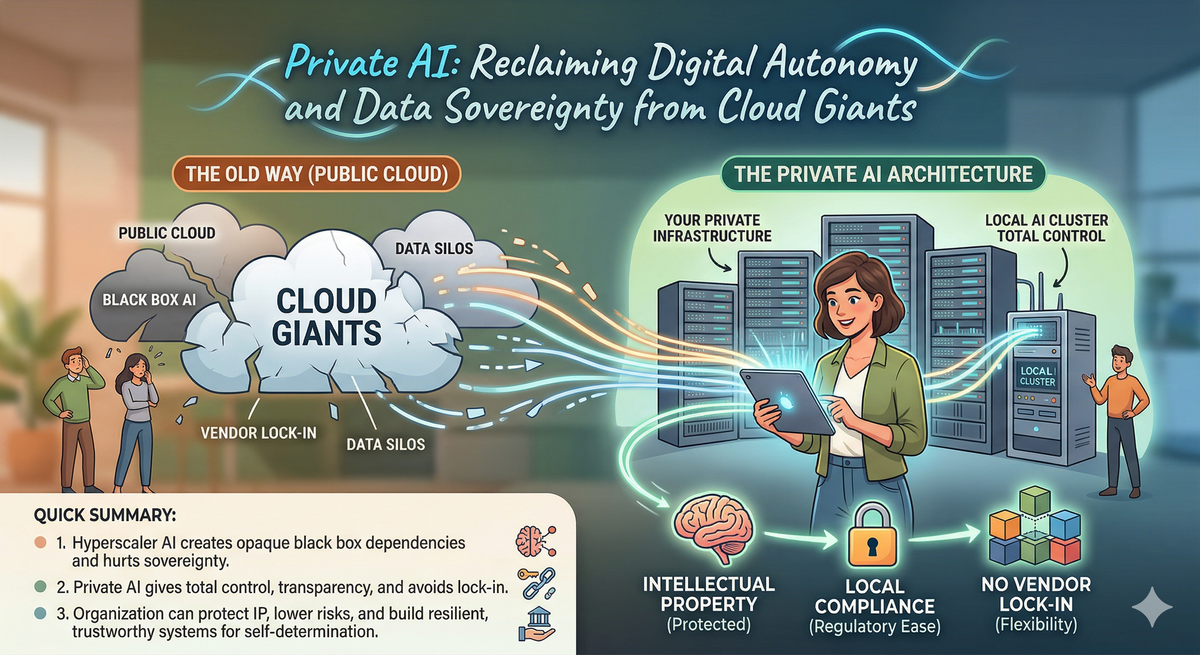
Quick Summary of the Main Ideas
- Hyperscaler AI centralizes power, creating opaque "black box" dependencies that hurt data sovereignty and accountability.
- Private AI infrastructure gives you total control over data, models, and processing, making sure you have transparency, can comply locally, and aren't locked into a single vendor.
- This architectural shift lets organizations protect their intellectual property, lower risks, and build trustworthy, resilient AI systems for real digital self-determination.
The Hidden Problems with "Cloud-First" AI (Why it's a Digital Surrender)
The current AI boom has quietly handed over digital control to a few huge, mainly US-based cloud companies (hyperscalers). These giants are not just infrastructure providers; they are the architects of the global AI ecosystem, controlling compute power and API standards, which forces new entrants to become dependent on them.
This dependency creates a critical "black box" problem: you're running mission-critical AI without visibility into the internal workings, such as model provenance, training data, and decision-making processes. Without being able to truly see into the algorithmic core, accountability is severely eroded, making companies vulnerable to biases, unexpected behaviors, and regulatory non-compliance, which puts operational stability and public trust at risk.
Using cloud-first AI is a strategic move that means giving up control over the intelligence that will drive future innovation and competitive advantage. Even when sensitive data is carefully stored in-country, the demands of AI inference often route processing to offshore environments due to GPU scarcity or global platform architecture.
Regulatory frameworks like GDPR, PIPEDA, and India's DPDP Act are escalating, and they increasingly define this temporary overseas processing as a sovereignty breach.
Control over data is unequivocally about where it is processed, which control plane governs it, and whether foreign legal regimes can compel access. This stark reality is forcing a necessary pivot towards Sovereign Private AI infrastructure.
Private AI: The Fix for Dependency and the Route to Real Sovereignty
The move to Private AI infrastructure is fundamentally designed to reclaim control, champion data freedom, and ensure local compliance. Deploying AI in a dedicated private cloud or using decentralized techniques like federated learning gives organizations direct control over every layer of their AI stack: hardware, GPU clusters, storage, security policies, and data pipelines.
This unparalleled control is a strategic necessity to avoid the significant financial, reputational, and ethical risks tied to opaque AI. Private AI dismantles the "black box" dependency by providing the crucial transparency and auditability required to understand how models reach conclusions, detect attacks (like data poisoning), and prevent systemic errors. This infrastructural autonomy directly addresses strict data residency rules, allowing organizations to maintain sensitive data within national borders under their explicit governance.
It means no longer being subject to the changing terms, data practices, or geopolitical pressures of a foreign cloud provider. By enabling models to be trained on distributed data without centralizing the raw information, organizations regain meaningful, verifiable control over their most strategic digital assets.
This approach establishes a "legal air gap," ensuring that neither training data nor inference prompts ever leave organizational custody, which nullifies the extraterritorial reach of foreign legal systems. The integration of privacy-enhancing technologies like homomorphic encryption with federated learning further strengthens this control, protecting against sophisticated model inversion attacks.
The Sovereignty Shift: You Own Your AI's Future
- Complete Data Custody and Residency:
- Organizations retain raw data within their own secure environments, whether on-premises, at the edge, or within a sovereign private cloud.
- This ensures all personal and transactional data processing remains within mandated geographical boundaries, impervious to foreign access requests.
- For example: A European bank using AI for anti-money laundering can ensure all transaction data and model inferences remain within the EU to meet GDPR and national financial regulations without needing cross-border data transfer agreements with external cloud providers.
- Full Model Ownership and Transparency:
- AI models are developed, trained, and deployed directly by the organization, providing unparalleled visibility into their architecture, training processes, and decision-making logic.
- This visibility is critical for regulatory approvals, intellectual property protection, and ensuring scientific integrity.
- For example: A pharmaceutical company developing an AI-powered drug discovery platform can meticulously document all training datasets and algorithmic modifications within its private environment.
- Also, for example: A national healthcare provider deploying Private AI for diagnostic assistance can allow their internal team of medical experts to thoroughly review the model’s decision-making process, ensuring fairness, mitigating biases, and building trust in AI-driven patient care.
- Strategic Autonomy and Immunity from Extraterritorial Laws:
- By owning and operating their AI infrastructure, companies can choose from a diverse ecosystem of open-source models and frameworks or develop proprietary solutions, rather than being beholden to the closed ecosystems and terms of a few hyperscalers.
- This significantly reduces exposure to foreign legal demands and jurisdictional ambiguities.
- For example: A national energy grid operator using AI for predictive maintenance can choose specific hardware and open-source AI frameworks, ensuring continuity and national security without being constrained by a foreign technology giant’s APIs or operational priorities.
- Also, for example: A government agency building a custom national language model on private infrastructure can utilize local linguistic datasets and academic talent, developing a capability tailored to their unique cultural and administrative needs without relying on a foreign vendor’s possibly biased or generic models.
The Plan Ahead: A "Sovereign-First" AI Future (The Next 12-24 Months)
The path for the next 12-24 months points toward an accelerating "sovereign-first" mindset becoming the default choice for mission-critical AI deployments. We can expect a rapid expansion of dedicated Private AI solutions across government sectors and regulated industries worldwide.
- Regulatory bodies will increasingly scrutinize the processing location and governance of AI workloads, making private AI a compliance necessity rather than just a strategic advantage.
- This architectural shift will boost local AI innovation, allowing nations and businesses to cultivate homegrown capabilities tailored to unique cultural values and linguistic diversity, as shown by sovereign AI initiatives in regions like Sarawak, Malaysia.
- Expect new architectural patterns that blend on-premises, edge, and sovereign private cloud deployments, all supported by robust privacy-enhancing technologies.
The era of blindly trusting external AI infrastructure is ending.
Instead, the future of AI belongs to those who meticulously control its core, ensuring accountability, resilience, and true digital self-determination. This is about safeguarding intellectual property, upholding ethical AI principles, and embedding accountability directly into the core of digital operations, not just avoiding vendor lock-in.